The Best Palm Reading Services Online in 2026 (Ranked for Depth of Analysis)
What makes an online palm reading worth doing
Most tools can spot the four major lines. The difference is what they do next. A shallow reader hands back a generic paragraph; a deep one interprets the length, depth, and curve of each line, factors in the mounts and hand shape, and ties it into a coherent picture rather than five disconnected sentences.
Depth of analysis is the ranking I care about, so that's how I've ordered this list. And one thing up front, in the spirit of the tools themselves: palmistry is a tradition, not a science. Read it for insight and fun, not as a forecast.
The best palm reading tools at a glance
Here's the shortlist, with what each one is really for.

Every one of these reads a palm. Where they split is depth, tradition, and whether the output is a paragraph or a full illustrated guide.
1. Overchat AI — best for a detailed, illustrated reading
Overchat leads because it treats a reading as more than a text dump. Its palm reading online scanner asks you to upload a clear photo, pick whether it's your dominant or non-dominant hand, and returns a personalized guide in about a minute.

What sets it apart is the output. Rather than a wall of text, it generates an illustrated guide with drawings of your palm's key areas — life, heart, marriage, fate, and money lines — each mapped and explained. The AI is trained on classic palmistry from India, China, and the West, so the reading blends traditions instead of leaning on one. The dominant/non-dominant choice matters too: the non-dominant hand is read for inherited potential, the dominant for how your choices have shaped it.

It's refreshingly honest, as well. The page states plainly that palmistry is a tradition rather than a science and that it doesn't claim to predict the future — a rare bit of candor in this category.
2. Palm Reader (Jenova) — best for cross-tradition depth
Jenova's palm reader is the analyst of the group. It synthesizes Western, Vedic, and Chinese palmistry, types your hand by element, reads major and minor lines plus the mounts, and even remembers past readings so you can ask follow-ups. It's free to start, with paid plans from around $20 a month. If you want the most thorough single reading and don't mind the cost, it's a strong pick.
3. Life Palmistry — best for a daily mobile habit
Life Palmistry is built for your phone. Alongside a palm scan it offers daily predictions and personality snapshots, which makes it more of an everyday check-in than a deep one-off analysis. The line detection is lighter than the tools above, but the daily-habit framing is genuinely fun if you like a quick morning read.
4. PalmistryHD — best for a fast, no-frills scan
PalmistryHD keeps things simple: point it at your palm, get the major lines detected, read the summary. There's no mount analysis or rare-marking detection, so it's shallow by design — but that's fine if you just want a quick, casual look without setting up an account or paying.
5. A general chatbot — best for the curious tinkerer
You can also just ask a general assistant like ChatGPT to read a palm photo. It's flexible and free to try, but it has no specialized palmistry training, doesn't reliably map lines, and gives a different answer each time you ask. Fun for a one-off, unreliable as a real reading.
What the lines actually mean
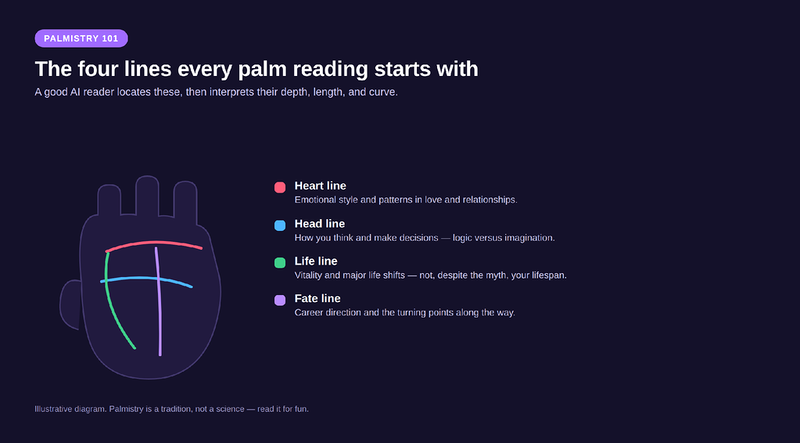
If you're new to this, the reading will name a few lines and mounts. Here's the quick translation for the ones that come up most.
Treat these as the traditional symbolism, not fixed fact. Half the fun is seeing how a reader interprets the same line differently.
More than a palm reader
It's worth zooming out on the tool at the top, because the palm scanner is one small feature of a much bigger app. Overchat is an all-in-one AI app with 150+ purpose-built tools for image, video, audio, and text generation, powered by the latest models from GPT, Claude, Gemini, Grok, Kimi, Qwen, and more, and it runs on web, iOS, and Android with 350,000+ users. Its Pro Access plan is $14.99 a month, or $59.99 a year — roughly what a single month of separate ChatGPT, Claude, and Gemini subscriptions would cost together. So the same account that read your palm can also generate a headshot, draft a caption, or summarize a document.
That's the practical case for a platform over a single-trick app: the novelty tool you opened for fun sits next to a hundred others you'll come back to.
How to get an accurate reading
Whatever tool you choose, the photo does most of the work. A blurry or badly lit shot hides the fine lines that a reading depends on, so it's worth taking thirty seconds to get it right.

Open your hand fully with the fingers slightly apart, use soft natural light instead of a hard flash, fill the frame so the creases are sharp, and pick the hand that matches what you want to learn. Do that, and even a lighter tool has something real to work with.
FAQ
- What's the best palm reading service online?
For a detailed, illustrated reading from one photo, Overchat AI leads — it maps your life, heart, fate, and money lines and explains each. Jenova's Palm Reader is the pick for the deepest cross-tradition analysis.
- Is online palm reading accurate?
It's for entertainment. Palmistry is a tradition rather than a science, and the better tools say so. AI makes readings consistent and detailed, but no scan can predict your future.
- Can I get a palm reading for free?
Yes, several tools let you try a reading at no cost, and some apps are freemium. Deeper analyzers like Jenova charge for full features, with paid plans from around $20 a month.
- Which hand should I photograph?
It depends what you're after. The non-dominant hand is traditionally read for inherited traits and potential; the dominant hand for how your choices have shaped your path.
- How do I take a good palm photo?
Open your hand with fingers slightly spread, use soft even lighting, and fill the frame so the lines are sharp. A clear, well-lit photo gives any reader far more to analyze.